Writing the wiki
Most of this wiki is generated; the rest is written by hand in wiki/pages/. Both are built by one
command, so a change to the mod shows up here the next time it is built.
Building it
python3 -m venv .venv-wiki && .venv-wiki/bin/pip install mkdocs-material pillow   # once
.venv-wiki/bin/python tools/wiki/build.py            # build into wiki/build/site/
.venv-wiki/bin/python tools/wiki/build.py --serve    # live preview at http://127.0.0.1:8000
The build fails on an unknown constant, a missing scene, or a broken link, so it doubles as a check.
The in-game guide
The same pages are the in-game guide, for GuideME. After changing the wiki, rebuild it and commit what it writes:
.venv-wiki/bin/python tools/wiki/guideme.py
It fills in constants, drops the mechanic badges, turns item links into GuideME's, and makes the
admonitions quotes and the tabs headings. Block and item pages get GuideME's own recipe view. The
reference section and this page are left out. The dev client asks GuideME to check every page once
a world loads: look for Compiling and any errors after it in run/logs/latest.log.
What is generated
- A page for every block and item, from the language file. Its icon is rendered from the real
model; its description comes from
wiki/data/descriptions.yml(one or two plain sentences, and the build fails if one is missing); its recipes, and the recipes that use it, come from the recipe files. - The Constants page: every numeric constant in the Java source.
- The Mechanics coverage page: see below.
To add written content to a generated page, create wiki/pages/blocks/<id>.md or
wiki/pages/items/<id>.md; it is merged in under the infobox.
Markup
| Write | Get |
|---|---|
{{c:Veiled.AREA}} |
A constant from the Java source: Class.NAME |
{{c:Veiled.PIN_TICKS|s}} |
Ticks as seconds; |min for minutes, |x20 for per-second |
[[item:rift_residue]], [[block:rift_anchor]] |
A link with the icon |
[[render:foundry]] |
An isometric render (the scenes in tools/block_preview.py) |
[[structure:reactor]] |
A multiblock in 3D that players can turn, in the in-game guide only. The structures in wiki/structures are built by GuideStructures and saved with ./gradlew runGameTestServer -PexportStructures; rerun it when a multiblock changes. |
[[recipes:quantimium:quantum_foundry]] |
Every recipe of a type, drawn |
[[mechanic:hall.residue.burn]] |
Declares a mechanic, with its test status |
Quote numbers with {{c:…}} whenever the code has them as a constant, so a balance change
cannot leave the wiki behind. Where a number lives in a method or a config file, write it out,
and mark the rule as a mechanic so a test pins it down.
GUI screenshots
The machine screens on these pages are real captures, kept in wiki/pages/assets/gui. To take
them again after a GUI change:
tools/wiki_shots.sh
It starts the game (it needs a display), creates a fresh creative flat world, builds every machine
with believable contents, opens each screen and saves the panel, cropped, at GUI scale 2. It then
quits by itself, in about a minute. The setup lives in client/dev/WikiScreenshots.java, and it
does nothing unless the game is started with -Dquantimium.wikiShots.
Embed a capture with the qgui class so it stays crisp:
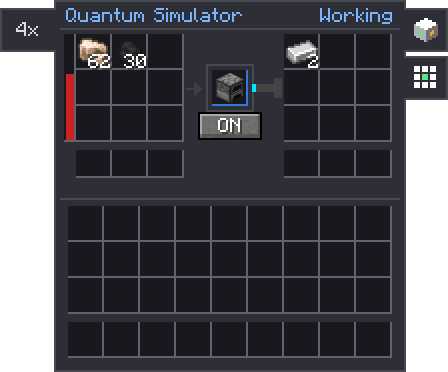{ .qgui }
The captures double as a layout check: look them over after touching a screen.
Mechanics and tests
Every rule a page states should carry a mechanic id: [[mechanic:area.rule]], just before the rule.
A GameTest covers a mechanic by naming it in a comment:
// covers: hall.residue.burn, hall.starve
@GameTest(template = "hall_one_arm")
public static void hallBurnsResidue(GameTestHelper helper) { ... }
The coverage report lists every documented mechanic and what tests it, so the untested rows are the test backlog. When you add a feature: write its page with mechanic ids, then write the tests that turn its badges green.
Running the tests
./gradlew runGameTestServer
A headless server builds each test on a stone floor, runs them all (it ticks as fast as it can, so a
thirty-second test takes a moment) and fails the build if any fail. In a normal dev world, /test
runall runs them where you can watch.
Tests live in src/main/java/com/kadikular/quantimium/gametest/; TestSupport builds halls, sets a
chunk's field and adds stand-in players. Three rules keep them honest:
- Tests share one world. Anything that reaches past its own floor (flux spreading across chunks,
a hall's 32-block reach, the one-Veiled-per-area rule, the dimension's rift list) runs in its
own
batch, and batches run one after another. - Clean up before succeeding. Break the hall, remove the rift, discard the Veiled, remove the player; otherwise they carry on into later tests.
- Test the rule the wiki states, not the code. Work the expected value out the way the page describes it. That is how the drain test caught the wiki being vague about bands.
Tick timing
TickTimingTests (and MiTickTimingTests with Modern Industrialization) time the machines that do
the most per tick, idle and working, alone and inside simulators. A mixin wraps the level's call into
each ticking block entity while a test is watching it, so the number is what a server profiler would
show. Each scenario gets its own batch, warms up, records every tick and reports the median to the
tick timing page (via wiki/data/tick-timing.json, so commit that
file). Each has a budget with plenty of headroom: it fails on a real regression, not a slower machine.
To see why something is slow, record a profile:
./gradlew runGameTestServer -Pjfr
That samples every millisecond into build/gametest.jfr and runs each timing scenario for 20,000
ticks so it shows up; jfr print --events jdk.ExecutionSample reads it.
Partner mod tests
Tests against other mods live in gametest/compat/, one class per mod (MiCompatTests,
Ae2CompatTests, HnnCompatTests). CompatGameTests registers each class only when its mod is loaded, so with the
mod missing its tests don't run at all, rather than passing without testing anything. They reach
the mod's blocks, items and fluids by id, so there is no compile-time dependency.
The test server runs in run-gametest/, with run/mods copied in first, bar client-only map mods
(JourneyMap breaks a dedicated server when the tests' fake players join). Its log is
run-gametest/logs/latest.log. ./gradlew runGameTestServer -PbareMods runs it with no other mods
at all, to prove none is needed; the partner tests then don't register. After updating a partner
mod in run/mods, run the tests:
anything the update broke fails straight away. See Partner mods for
what they cover.