Zeno Field Controller

| Type | Random tick control |
|---|---|
| Tier | Mid |
| Energy buffer | 500,000 FE |
| Max input | 10,000 FE/t |
| Field | A cube, radius 1 to 8 (3×3×3 to 17×17×17) |
| Modes | Hold, or accelerate 2×, 4×, 8× or 16×, as far as the flux band allows |
A watched pot never boils. The quantum Zeno effect says a system watched closely enough never changes. The Zeno Field Controller watches a cube of the world. In Hold mode nothing in it changes by chance: crops stop growing, leaves stop decaying, ice and snow stop melting, copper stops weathering, grass and mycelium stop spreading. In Accelerate mode it does the opposite, and those changes come faster.
It only touches random ticks, the chance-driven updates vanilla gives blocks now and then. Machines, redstone, furnaces and other block entities in the field work as normal.
Badges
Badges like tested show whether an in-game test backs the rule next to them. See Mechanics coverage.
Settings
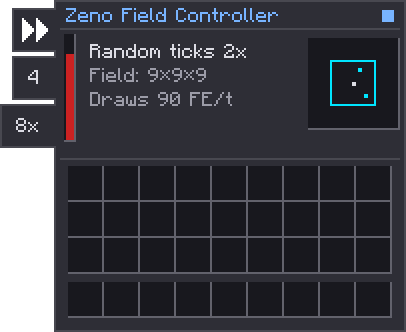
The three tabs down the left of its screen (right-click steps a value back):
| Tab | Does |
|---|---|
| Hold / accelerate | Switches between Hold and Accelerate |
| 4 | The radius: the field is every block within this many blocks of the controller, in each axis, 1 to 8, wrapping round. |
| 8x | Accelerate only: how many times the usual random tick rate: 2×, 4×, 8× or 16×. |
The diagram on the right shows the field to scale: frosted while holding, ticking while accelerating.
Hold
tested While powered, nothing inside the cube is picked for a random tick. It covers blocks and fluids, and takes effect the tick the controller powers up; it lifts two ticks after it loses power, is broken or is switched to Accelerate.
tested Holding costs 10 FE/t per block of radius. It follows the radius, not the volume, so a big field isn't punishing:
| Radius | Field | Cost |
|---|---|---|
| 1 | 3×3×3 | 10 FE/t |
| 4 | 9×9×9 | 40 FE/t |
| 8 | 17×17×17 | 80 FE/t |
Uses. Keep a build exactly as it is: leaves on a custom tree that isn't attached to logs, ice in a sculpture, unwaxed copper at the shade you like, a lawn that shouldn't spread into a path.
Accelerate
tested The controller gives extra random ticks to random spots in its cube, at
the rate vanilla would give them, times the factor, less the ticks vanilla already gives. At 4× a field
gets its own random ticks plus three times as many again. Vanilla picks 3 blocks per 16×16×16
section each tick (the randomTickSpeed game rule), so an accelerating field adds:
extra random ticks per tick = randomTickSpeed × (factor − 1) × blocks in the field ÷ 4096
tested A hotter field runs faster. The fastest rate depends on the flux band
where the controller stands: 2× at Low, 4× at Medium, 8× at High, and 16× at
Critical and Singularity (config zenoField.maxFactorByBand). A faster rate chosen runs at the
band's until the field is hot enough. At Singularity accelerating costs 75% of its usual FE
(zenoField.singularityCostPercent). Holding works in any field.
tested It costs 45 FE/t for each step of factor above 1, per half block of radius:
FE/t = 45 × (factor − 1) × radius ÷ 2
Like holding, it follows the radius rather than the volume: the widest field does a lot more work for the same price per step.
| Radius | Factor | Extra ticks a second | Cost |
|---|---|---|---|
| 2 (5×5×5) | 4× | 5.5 | 135 FE/t |
| 4 (9×9×9) | 8× | 75 | 630 FE/t |
| 8 (17×17×17) | 16× | 1,080 | 2,700 FE/t |
With random ticks switched off (randomTickSpeed 0) it adds nothing and costs nothing.
Uses. Crops, sugar cane, cactus, bamboo and saplings grow faster; amethyst buds form faster; kelp and vines climb faster.
Upkeep isn't sped up. Some blocks' random tick is upkeep rather than growth, and costly on a server with a field running hard:
- tested Blocks in
#quantimium:zeno_ignoredget no extra ticks. By default that is farmland, whose tick only checks for water nine blocks across: the crops on it grow just as fast. - tested Blocks in
#quantimium:zeno_slowedget a share of them,slowedTickChancein the config (1 in 8 by default). By default that is grass and mycelium, so they still spread faster, just not 16 times faster.
Both keep their normal ticks. Packs can add to either tag.
tested A cap, if you want one. maxExtraTicksPerTick in the zenoField config
section limits the extra random ticks one controller adds each tick, counting every copy when it runs
in a Simulator. It is 256 by default: about five of the biggest, fastest fields (radius 8 at 16×
adds about 54 a tick), so a Simulator can still multiply one, but nested Simulators can't multiply
it 64 times over. Set it to 0 for no cap. The FE cost doesn't change with it.
tested Hold wins. A block inside both a holding and an accelerating field is held: the accelerating controller skips it.
In a Quantum Simulator
tested A controller taken into a Quantum Simulator keeps working, centred where it stood (now the Simulator's field block). Accelerating, every copy in the Simulator's batch adds its own extra ticks: an 8× controller in a Simulator at 4× batch gives the field four times the extra ticks. The Simulator pays for every copy, plus its 20% overhead: 4 × 630 × 1.2 = 3,024 FE/t for the radius 4, 8× example above.
tested Nesting multiplies. A Simulator holding a Simulator holding a controller runs the product of the two batches: 8× within 8× is 64 copies, though the extra ticks still stop at the cap above. Each Simulator adds its own 20% overhead, and both keep running for as long as they're powered.
Holding doesn't multiply: a field is either still or it isn't.
Flux
Like every Quantimium machine, it emits 1 flux per 1,000 FE it spends. A large field at 16× is a steady source of flux; plan containment round it. Inside a Simulator the Simulator emits the flux instead.
Recipe
Four polished deepslate, two packed ice and two clocks round a Quantimium Trace.