Quantum Crafter

| Type | Instant crafting machine |
|---|---|
| Tier | Mid (the Basic Quantum Crafter is Low) |
| Energy buffer | 100,000,000 FE |
| Max input | 10,000,000 FE/t |
| Slots | 9 input, 54 output, 1 catalyst |
| Automation | Items, all six faces |
| Emits | 1 flux per 1,000 FE spent |
The Quantum Crafter does what another machine does, instantly, and bills you for skipping the wait. Put a machine in the catalyst slot (a furnace, a crafting table, a Modern Industrialization macerator) and ingredients in the grid. Every craft that machine could make from them appears in the output grid as a faint preview. Taking one makes it real.
It never runs on its own schedule. Nothing is crafted until something takes an output: you, a hopper, a pipe, or its own auto-output.
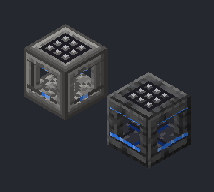
Badges
Badges like tested show whether an in-game test backs the rule next to them. See Mechanics coverage.
At a glance
| Basic Quantum Crafter | Quantum Crafter | |
|---|---|---|
| Energy buffer | 1,000,000 FE | 100,000,000 FE |
| Max input | 1,000,000 FE/t | 10,000,000 FE/t |
| Catalysts | Vanilla workstations only | Anything on the whitelist |
| Runs | 32 at a time, then it recovers | Unlimited |
| Automation | Every face, no configuration | Per-face side configuration, auto input and output |
| Tesseracts in the grid | Yes | Yes |
A Basic crafter's buffer takes about 8 minutes to fill from a 100 FE/t generator.
The catalyst
tested The catalyst slot decides which recipes the crafter can make. It takes one machine and never uses it up.
| Catalyst | Recipes |
|---|---|
| Crafting Table | Crafting (shaped and shapeless) |
| Furnace | Smelting |
| Blast Furnace | Blasting |
| Smoker | Smoking |
| Stonecutter | Stonecutting |
| Campfire, Soul Campfire | Campfire cooking |
| Modern Industrialization machines | That machine's recipe type (an electric macerator makes macerator recipes; MI furnaces also do vanilla smelting) |
| Mekanism machines and factories | Enriching, crushing, combining, smelting |
| Applied Energistics 2 Charger, Inscriber | Charger and inscriber recipes |
Machines outside that list are matched by name: a catalyst whose id contains a recipe type's name
drives that type, with prefixes like electric_, steel_ or lv_ ignored.
tested A catalyst must be on the #quantimium:quantum_crafter_whitelist
tag and not on #quantimium:quantum_crafter_blacklist; the blacklist always wins. Anything else
shows Not allowed and the preview stays empty. Modpacks add machines by tagging them.
The whitelist is built from four tier tags:
quantum_crafter_catalysts/basic: Crafting Table, Furnace, Blast Furnace, Smoker, Stonecutter,
Campfire, Soul Campfire. These are also the only catalysts the Basic Quantum Crafter takes.
quantum_crafter_catalysts/advanced:
- Applied Energistics 2: Charger, Inscriber
- Hostile Neural Networks: Loot Fabricator (see Partner mods)
- Modern Industrialization: bronze, steel and electric compressors, cutting machines, furnaces, macerators and mixers; steel and electric packers, unpackers and wiremills; Assembler, Centrifuge, Chemical Reactor, Distillery, Electrolyzer, Polarizer
- Mekanism: Enrichment Chamber, Crusher, Energized Smelter, Combiner, and the enriching, crushing, smelting and combining factories of every tier
quantum_crafter_catalysts/industrial: Modern Industrialization's bronze and steel boilers, Coke
Oven, Steam and Electric Blast Furnaces, Implosion Compressor, Vacuum Freezer, Distillation Tower,
Heat Exchanger, Oil Drilling Rig and Nuclear Reactor.
quantum_crafter_catalysts/singularity: Modern Industrialization's Fusion Reactor.
quantum_crafter_blacklist: Modern Industrialization's Forge Hammer.
tested Each tier needs a flux band where the crafter stands: the basic
catalysts work anywhere, advanced ones need Medium, industrial ones High, a multiblock's
controller without its structure Critical (until folding comes), and the Fusion Reactor
Singularity (config crafter.catalystBands). Below it the preview stays empty and the status
says Needs flux, with the band needed and where the field is heading.
The preview
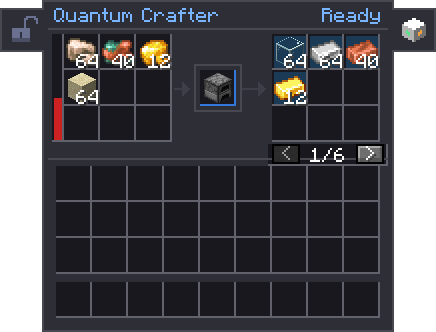
tested Every craft the catalyst can make from the grid's contents is shown in the output grid as a faint ghost stack, sized to the largest batch it could make right now. The panel reads "Wavefunction preview — take to collapse".
- The grid holds up to 54 stacks of ghosts. A craft with several outputs is shown whole or not at all.
- Block and nugget results come first, then the crafts that use up the most.
- Ingredients are pooled. Nine iron ingots in one slot fill all nine positions of an iron block recipe; positions in the grid don't matter.
- A craft is shown only if everything it needs is there, energy included. When energy is what limits a batch, the tooltip says "Batch limited by stored energy, not ingredients".
- If any grid slot holds a blacklisted item, the whole preview stays empty.
Taking an output: collapse
tested Taking a ghost commits that craft. The ingredients and energy are taken, the ghost becomes the real items, and the preview is worked out again from what is left.
- Taking it by hand commits the batch shown.
- A hopper or pipe pulling from the output grid commits only as many runs as it takes. A hopper pulling one item at a time crafts one item at a time.
- Anything made beyond what was taken is kept as real items in the output grid: the second product of a two-output craft, or the rest of a run when a hopper takes less than one run makes. If the grid has no room for it, the take is refused.
tested The last recipe you took becomes the preferred recipe and is listed first. The recipe lock shows only that recipe whenever it can be made, which stops a shared grid, or auto output, from making something else. When it can't be made, the full preview comes back.
Batch size
tested One take makes as many runs as the smallest of three limits allows:
| Limit | Runs allowed |
|---|---|
| Ingredients | As many full sets as the grid (and any linked inventories) holds |
| Energy | Stored FE ÷ FE per run |
| One stack of output | Output's max stack size ÷ output per run |
Example. A furnace catalyst, 64 raw iron in the grid, 100,000 FE stored. Ingredients allow 64 runs and a stack of ingots allows 64, but at 4,000 FE a smelt the energy allows only 25. The ghost shows 25 iron ingots.
Unrealised Matter goes through a catalyst unobserved: it comes out as Matter that remembers the
step (see  Unrealised Matter).
Energy cost
tested Every craft is billed at what the real process would have cost, times the
instant-craft multiplier (config crafter.instantCraftMultiplier, default 2, range 1–100).
The multiplier is the price of skipping the wait.
A hotter field pays less of it. The Quantum Crafter charges the full multiplier at Low and
Medium, 80% of it at High, 65% at Critical and 55% at Singularity: at the default, 2.0×, 2.0×,
1.6×, 1.3× and 1.1× (config crafter.taxPercentByBand).
| Recipe | Base cost | At the default ×2 |
|---|---|---|
| Crafting table | 100 FE | 200 FE |
| Stonecutting | 100 FE | 200 FE |
| Smelting (200-tick cook) | 10 FE per tick of cook time: 2,000 FE | 4,000 FE |
| Blasting, smoking (100 ticks) | 1,000 FE | 2,000 FE |
| Campfire (600 ticks) | 6,000 FE | 12,000 FE |
| Modern Industrialization | Total EU × MI's forgeEnergyPerEu (default 10) |
EU × 20 |
| MI recipe with no EU draw | 10 FE per tick of its duration | 20 FE per tick |
| AE2 Charger, Inscriber | 1,600 FE | 3,200 FE |
| Mekanism enriching, crushing, smelting | 2,000 FE | 4,000 FE |
| Mekanism combining | 2,500 FE | 5,000 FE |
| Anything else | 200 FE | 400 FE |
- No craft is free. Every run costs at least 100 FE.
- Modern Industrialization costs are converted with MI's own config, read live, so the two energy economies agree. A recipe drawing 8 EU/t for 200 ticks is 1,600 EU, or 16,000 FE before the multiplier and 32,000 FE after it.
- Anomaly surcharge. tested Above Low anomaly, every craft costs more: +10% at Medium, +25% at High, +50% at Critical, +100% at Singularity. A 4,000 FE smelt costs 5,000 FE at High. The GUI's energy bar shows the surcharge in force.
- Passive drain. Above Low anomaly the buffer also leaks a flat 16–160 FE/t. See Flux and anomaly.
The costs of the AE2 and Mekanism recipes come from data files in data/quantimium/recipe_adapters,
which packs can add to (see Recipe adapters below).
Flux
tested Each committed craft emits 3 flux per 1,000 FE it cost, into the 3×3 of chunks round the crafter: a fifth to its own, a tenth to each of the others. It adds no anomaly of its own; flux drives that. A craft that cost nothing still emits a flat 1 flux (times the same 3).
Example. A stack of 64 raw iron smelted at Low anomaly costs 256,000 FE and emits 768 flux, about 154 in the crafter's chunk and 77 in each of the eight round it. Do that every few minutes in one place and the chunk climbs towards Medium.
Automation
tested Items only; the crafter has no fluid ports.
Quantum Crafter. The side configuration (the Sides tab) sets each face to Off, In, Out or Both, and which grid slots and output slots it reaches. Every face starts as Both. With auto input, a face pulls from the block beside it once a second; with auto output, it commits and pushes a craft into it, sized to the room the neighbour has. Auto output uses the preferred recipe when it is available, otherwise the first one in the preview.
Basic Quantum Crafter. Every face is both an input and an output, with no configuration and no auto push or pull. Hoppers and pipes do the moving.
Automation reaches the grid and the output slots only; the catalyst goes in by hand.
Tesseracts in the grid
tested A bound Tesseract in a grid slot adds the linked inventory's contents to the ingredient pool, wherever it is. A Semi-Stable Tesseract does the same for inventories within 16 blocks. Taking a craft pulls the ingredients straight out of the linked chest.
Links are polled every half second, and the crafter looks for newly reachable inventories once a second, so a chest filled from elsewhere updates the preview within a moment.
A Tesseract can be bound to another crafter. Its output ghosts then count as ingredients, so one crafter can plan its craft from another's preview: plank → stick → torch in one take.
tested Crafters linked in a ring (A reads B, B reads A, or a longer chain back to itself, up to 16 links deep) would try to craft from themselves. Every crafter in the loop stops with Link loop until a link is taken out.
The Basic Quantum Crafter
The low-tier crafter. Same preview and costs, with three limits:
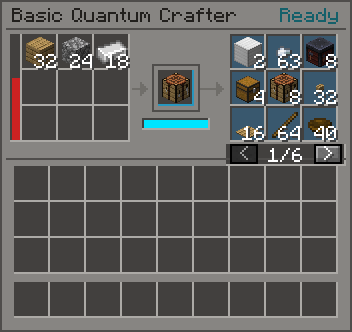
- tested Vanilla workstations only: the
quantum_crafter_catalysts/basictag. Anything else shows Not allowed. - A small buffer: 1,000,000 FE, enough for 250 smelts.
- tested Coherence. It holds a reserve of 32 runs (config
basicCrafter.coherenceCapacity). Each run it commits uses one, and a batch is never larger than the reserve left. The reserve refills steadily, a full reserve every 5 seconds (configbasicCrafter.coherenceRefillTicks, 100 ticks). While it is empty the crafter shows Recovering.
In practice a Basic crafter makes about 6 runs a second, sustained, in bursts of up to 32.
Status
| Status | Meaning |
|---|---|
| Idle | No catalyst or no ingredients |
| Ready | A preview is up; take an output to craft |
| No power | A craft matches but the buffer can't pay for one run |
| No recipe | The catalyst makes nothing from these ingredients |
| Not allowed | Not on the whitelist, or on the blacklist |
| Output blocked | The output side has nowhere to put the craft |
| Link loop | Crafters linked in a ring; see above |
| Recovering | Basic only: coherence is used up |
| Needs flux | The catalyst's tier needs a hotter field here |
See Partner mods for what is tested with Modern Industrialization and AE2.
Recipe adapters
Mods whose recipes aren't furnace-like or Modern Industrialization recipes can be supported with a
JSON adapter in data/<namespace>/recipe_adapters/. The built-in ones cover the AE2 Charger and
Inscriber, Mekanism's item machines, and the machines listed on Partner mods.
The EnderIO Alloy Smelter's:
{
  "recipe_types": ["enderio:alloy_smelting"],
  "catalysts": ["enderio:alloy_smelter"],
  "catalyst_also": ["minecraft:smelting"],
  "input_mode": "field",
  "input_fields": ["inputs"],
  "output_mode": "field",
  "output_fields": ["output"],
  "energy": { "flat": 2000, "field": "energy" }
}
input_fieldsandoutput_fieldsname the recipe's own fields. Inputs can be ingredients, sized ingredients, or a mod's own wrapper with a count; outputs can be stacks, stack templates, or a mod's own wrapper. Only what a recipe always gives is counted: an output with achancebelow one, or withpercentagesthat can miss, is left out, and a recipe that only might give anything isn't offered. A field a recipe doesn't have gives nothing, so one adapter can serve several recipe types.catalystsare the machines that run these recipe types, for machines whose names don't say so.catalyst_alsoadds other types they run too. Machines still have to be on a catalyst tag.energy.flatis the base FE before the instant-craft multiplier.energy.fieldreads the recipe's own energy instead, timesenergy.scale(1 if left out), with the flat fee if it can't be read.non_consumed_tagsandnon_consumed_itemslist ingredients that stay in the grid, like the Inscriber's presses.
Tips
- Keep the ingredients linked, not loaded. A Tesseract to your storage chest turns the crafter into a crafting terminal for the whole chest.
- Lock the recipe before turning on auto output, or it will make whatever the preview lists first.
- Mind the flux. Crafting in bulk is the fastest way to raise a chunk's flux, and anomaly follows.