Quantum Simulator

| Type | Machine parallelizer |
|---|---|
| Tier | Mid |
| Energy buffer | 10,000,000 FE |
| Max input | 1,000,000 FE/t |
| Slots | 9 input, 9 output |
| Tanks | 3 input, 3 output, 32,000 mB each |
| Batch | 1× to 32× (default 2×), as far as the flux band allows |
| Automation | Items and fluids, every face but the top |
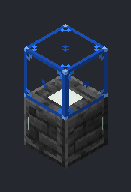
The Quantum Simulator takes a real machine into a containment field and runs it several times over at once. Place a machine on top, engage the field, and feed the simulator: it runs the machine as it would run in the world, at its own speed, with the work of 1, 2, 4 or 8 copies happening each tick.
Where the Quantum Crafter skips a machine's wait, the Simulator keeps the wait and multiplies the output. It works with machines the Crafter can't read, since it doesn't need to understand their recipes: it runs the machine itself and watches what it does.
Badges
Badges like tested show whether an in-game test backs the rule next to them. See Mechanics coverage.
Engaging the field
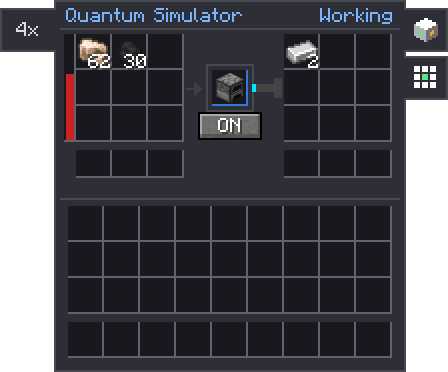
tested Put a machine on the block directly above the Simulator and press the field button in its GUI.
- The machine is lifted out of the world, with everything in it, and replaced by a glowing, unbreakable Quantum Containment field (light level 12). A small model of the machine turns inside the field.
- The machine's item shows in the Simulator's display slot.
- Unbreakable blocks, like bedrock, can't be taken.
- Any block can be taken, but only one with item slots or fluid tanks does anything (see Statuses). The exceptions are machines whose work is on the world around them: the Zeno Field Controller, where every copy adds its own extra random ticks, and the field blocks, where every copy raises flux or pulls anomaly.
tested Pressing the button again puts the machine back, contents and all. If it can't be put back, its items drop at the Simulator's feet rather than being lost.
Breaking the Simulator disengages first, so the machine comes back, and drops the grid and output items. Fluids in the Simulator's own tanks are lost.
Slot mapping
tested On engaging, the grid is mapped onto the machine's input slots, cycling through them: a furnace has an ingredient slot and a fuel slot, so grid slots 1, 3, 5, 7 and 9 feed the ingredient slot and 2, 4, 6 and 8 the fuel. Input tanks are mapped the same way. What the machine makes goes to the output slots and tanks.
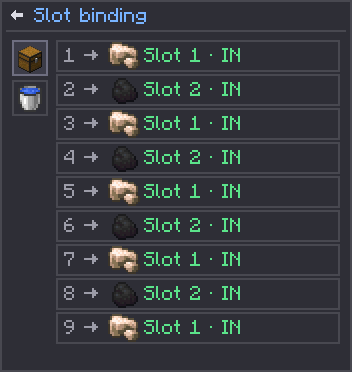
Open the Slots tab on the right to change it; it opens in the Simulator's own frame. Each grid slot can be:
- bound to one machine slot;
- Auto, sending its item to whichever machine slot will take it;
- Locked, closed to items entirely.
Click a row to step it on, right-click to step back; each change is saved as you make it. The auto-detect tab on the left, while the page is open, maps it again from scratch.
tested Machines that take only their own items. The Simulator first sorts a machine's slots by offering each a few common items (coal, raw iron, cobblestone, redstone). A machine that only takes its own items, like a Hostile Neural Networks chamber, refuses all of them, so none of its inputs is found this way. An Auto grid slot then asks the machine's other slots with the item actually in the grid, and learns the first slot that takes it as an input. Put things in the grid in the order the machine needs them: a data model before the matrices it unlocks.
Mappings are kept when you disengage. Engage the same machine again and your layout is still there; engage a different one and it is mapped afresh.
Batch size
tested The batch tab (left; click for more, right-click for fewer) cycles 1×, 2×, 4×, 8×, 16× and 32× (default 2×): how many copies of the machine run in parallel.
tested A hotter field runs bigger batches. The largest batch that runs
depends on the flux band where the Simulator stands: 2× at Low, 4× at Medium, 8× at High,
16× at Critical and 32× at Singularity (config simulator.maxBatchByBand). Choose a larger
batch and it runs at the band's size until the field is hot enough; the tab's tooltip says what it
runs at and what it needs.
Every tick the machine runs once, on copies of what is in the grid. The Simulator measures what changed (ingredients used, output made, fuel burnt, energy drawn) and applies that change batch times to the real items.
- Speed is the machine's own. A furnace still takes 10 seconds a smelt; at 8× it smelts eight items in those 10 seconds.
- The batch is a ceiling. The Simulator runs as many copies as the grid can pay for, up to the batch size: five raw iron at 8× smelt five at a time. When the grid can't pay for even one copy of what the machine wants next (a tool that would break partway, say), it waits on Low input.
- Fuel is multiplied with the work it pays for. At 8×, one coal in the grid burns at 1× and pays for eight smelts one at a time, as it would in a furnace. Eight coal burn together and pay for the same eight smelts, run in parallel. A coal is always worth eight smelts; more fuel buys more parallel work.
Energy cost
tested The Simulator pays for everything the machine draws, for every copy, plus 20% entanglement overhead, then the anomaly surcharge:
FE per tick = (the machine's own draw × batch) × 1.2 × anomaly surcharge
tested A machine with no power of its own (a furnace, a smoker) is billed a baseline 20 FE/t per copy while it is busy. An idle machine costs nothing.
| Machine | Batch | Cost |
|---|---|---|
| Furnace | 2× | 20 × 2 × 1.2 = 48 FE/t (4,800 FE per item smelted) |
| Furnace | 8× | 20 × 8 × 1.2 = 192 FE/t (still 4,800 FE per item) |
| A machine drawing 80 FE/t | 4× | 80 × 4 × 1.2 = 384 FE/t |
| The same at High anomaly | 4× | 384 × 1.5 = 576 FE/t |
Bigger batches go faster, but the cost per item doesn't change.
tested Powering the machine. A powered machine is charged from the Simulator's buffer through whatever it accepts:
- NeoForge energy (FE)
- Mekanism Joules
- Long-precision energy (GrandPower, Modern Industrialization EU)
- Modern Industrialization's own energy components
If none of them will take a charge, it shows No power link: "It will not start a recipe until it can be powered."
tested Running short. Work already done is always paid for. If the buffer can't cover a tick, the shortfall is kept as debt, and nothing more runs until the debt is paid off from new energy. The status shows No power meanwhile.
Above Low anomaly, the buffer also has the passive leak of 16–160 FE/t that every Quantimium machine has. See Flux and anomaly.
Flux
tested The Simulator emits 3 flux per 1,000 FE it is charged, once a second, into the 3×3 of chunks round it, a fifth to its own. It adds no anomaly of its own. A furnace at 8× running all day emits about 11.5 flux a second. A Simulator running inside another emits nothing itself: the outer one is charged for everything the inner one draws, and emits for all of it.
Automation
tested Every face except the top, which is the field. The side configuration (the Sides tab; see Side configuration) sets each face to Off, In, Out or Both for items and fluids separately, and chooses which grid slots and tanks it reaches. With auto input or output on, a face moves items and fluids to or from the block beside it once a second.
The engaged machine itself isn't in the world, so pipes can't reach it. Everything goes through the Simulator.
How it decides to wait
The Simulator doesn't know a machine's recipes, so it learns how the machine behaves:
- Initialising. It first offers the machine a single copy of each ingredient, then more (up to 64) every second until the machine takes what it needs, and measures a first cycle before it scales up. The status reads Calibrating. A machine whose work is an effect rather than items, like a Zeno Field Controller, has no cycle to measure and reads Working from the start.
- Stalled. A machine that sits on what it was given for 10 seconds without doing anything is left alone and the status reads Stalled. Changing the grid (a recipe it knows, the fuel or catalyst it is missing) wakes it.
- Winding down. Once empty, a machine keeps ticking for up to 30 seconds so it can wind down the way it would in the world (Modern Industrialization machines bleed off their overclock).
- Unfinished jobs. A machine that took ingredients for a job keeps running for up to 5 minutes to finish it.
Statuses
| Status | Meaning |
|---|---|
| Field off | The field is off |
| Working | Running the machine |
| Idle | Waiting for input in the grid |
| Calibrating | Measuring the machine's first cycle |
| Low input | The grid can't pay for even one copy of what the machine wants next |
| No power | The buffer can't cover the work, or is paying off debt |
| No power link | The machine needs power but refuses the Simulator's charge |
| Output full | The output slots or tanks are full |
| Stalled | The machine does nothing with what it was given |
| No route | The machine refuses every item in the grid; open the slot configuration to rebind or unlock a slot |
| Unsupported | The block has no item slots or fluid tanks |
| No tick | The machine isn't driven by block ticks (it is run by its own network, as AE2's are), so ticking it does nothing |
See Partner mods for which Modern Industrialization and AE2 machines the Simulator runs.
Simulating a simulator
untested An engaged Simulator can be taken into another Simulator's field. Doing it awards Simulation Within a Simulation. The field shows the inner Simulator and the machine inside it, two levels deep.
tested Nesting multiplies the batches (8× within 8× is 64 copies), so a pack
can cap how many Simulators a chain may hold with maxNestingDepth in the simulator section of the
config: 2 by default (one Simulator in another), 1 for no nesting at all. A Simulator refuses to take a
chain that's too deep, and says so.
Tips
- Set the batch high. It is only a ceiling: a short grid runs fewer copies rather than waiting, and the cost per item is the same at any batch size.
- Composters work. The Simulator composts in batches like any other machine.
- Crafter or Simulator? If the Crafter can read the recipe, it is faster and costs less per item (4,000 FE a smelt against 4,800). Use the Simulator for machines with their own logic, power or fluids.