Fold Chamber
A multiblock left standing as a catalyst would still tick and still be usable, and nothing stops another mod's machines from doing either. So the Fold Chamber folds it: the whole structure goes into a Tesseract, which becomes a Folded Tesseract. Folded, a machine can't tick or be touched, and in a Quantum Crafter it is a catalyst for everything the machine makes. Unfold it in a chamber to stand it up again.
For now the chamber folds our own Quantum Foundry. Other mods' multiblocks come one by one, each with its own fold adapter that knows when that machine is formed, idle and empty, and what about it to keep.
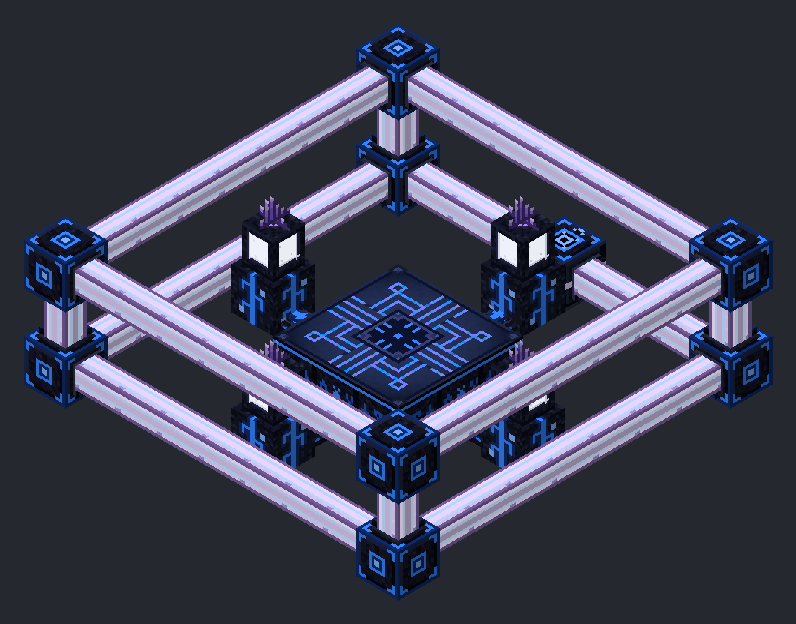
The frame
tested The frame marks out a box and is the volume:
- a
 Fold Pylon on each of the eight corners;
- Fold Rails along the twelve edges between them. A rail turns to its edge as you place it, and rails in a row read as one tube;
- the
 Fold Core in the middle of any bottom edge, in place of a rail. Place it from
outside the chamber, facing you; the Tesseract floats over its socket on top.
Each side is 3 to 17 blocks long, built to size on its own, and the width (along the core's edge) is odd so the core sits in the middle. The core reads the width from the rails either side of it, then the height and depth from the rails up and back from a front corner; every other edge has to match. A whole frame lights up.
Everything inside the box folds, its faces included; only the edges are frame. So build the frame round the machine, a block clear of it on every side it reaches. A Foundry, 7×7 and two tall, takes a 9 × 3 × 9 chamber, standing on the ground level with the bottom rails and centred four blocks back from the core. A 7-wide chamber is too narrow: the Foundry's arms would reach the side faces, and their tanks would sit on the top edges where rails have to go. If a block stands where the frame's edge should be, the core says which.
Folding
- Build the machine inside and let it form.
- Bind a Tesseract to its controller: sneak-use it on the controller. That tells the chamber which block is the machine.
- Put the Tesseract in the core's socket and press Fold.
tested The core's screen says what the chamber makes of its socket, twice a second: why it can't fold, or how many blocks a fold would take and what it costs. Nothing moves until you press the button. Then the chamber seals for 3 s, with the socket locked, checks everything again and folds the whole volume at once. Folding costs 2,000 FE a block, from a 10,000,000 FE buffer that takes up to 100,000 FE/t from any side; unfolding is free. The screen keeps it short; hover the status for the whole message.
tested The Tesseract comes out a Folded Tesseract, with the controller turning inside its violet shell. Its tooltip says what it holds, the box it was folded from and how much room it needs, east–west × height × north–south.
When it won't fold
tested The rules for this first version are strict on purpose: moving contents across a fold is the classic way to duplicate them, so contents never cross a fold. The chamber refuses, and says why, when:
- the Tesseract isn't bound, or is bound to something outside the chamber, or to a block no fold adapter knows. (An unbound Tesseract in an empty chamber would collapse into a Singularity. Not yet.)
- the machine isn't formed, is part way through a recipe, or holds items;
- any other block in the volume holds items, fluid or energy;
- anything in the volume is unbreakable, or on the
#quantimium:unfoldabletag (for pack makers).
A Foundry's own energy doesn't refuse a fold: the Foundry only takes power in, so there would be no way to empty it. It is lost when the Foundry folds.
Unfolding
tested Put a Folded Tesseract in a core and press Unfold. It needs:
- a chamber with room for the machine's blocks, clear of its frame. The chamber it was folded in doesn't matter: a Foundry folded in a roomy 13 × 5 × 13 still unfolds in a 9 × 3 × 9. Nor does which edge the core is on;
- every cell the machine needs to be empty. The core names the first block in the way.
A fold never rotates: the machine stands up the way it was built, north still north, centred in the chamber, as high off its floor as it stood before if there's room, else as low as fits. It forms again from scratch, so nothing in it remembers where it used to be. You get the Tesseract back, bound to the controller where it now stands, ready to fold it again.
In a Quantum Crafter
tested A Folded Tesseract in a Quantum Crafter's catalyst slot runs every recipe the machine does, at once. A folded Foundry makes the Foundry's recipes, but only those its arms allow: one folded with two arms won't make a three-arm recipe. Like any multiblock catalyst it needs a Critical field. It is priced at the energy the Foundry itself would spend on the recipe, taxed like any instant craft, and shows up as patterns for an ME Superposition Crafter too.